Why does my plant have brown spots on its leaves?
Short answer
Brown spots on plant leaves are most often a fungal leaf spot: small brown spots, often with a yellowish edge, that spread when leaves stay wet. Water-soaked spots with a yellow halo point to bacteria. Patches on leaves facing the sun are sun scorch, and patches after a cold spell are cold damage. On plumeria, yellow-orange powder under the leaves means rust. Remove spotted leaves and keep the foliage dry. Outdoors, most leaf spots on trees and shrubs are only cosmetic.
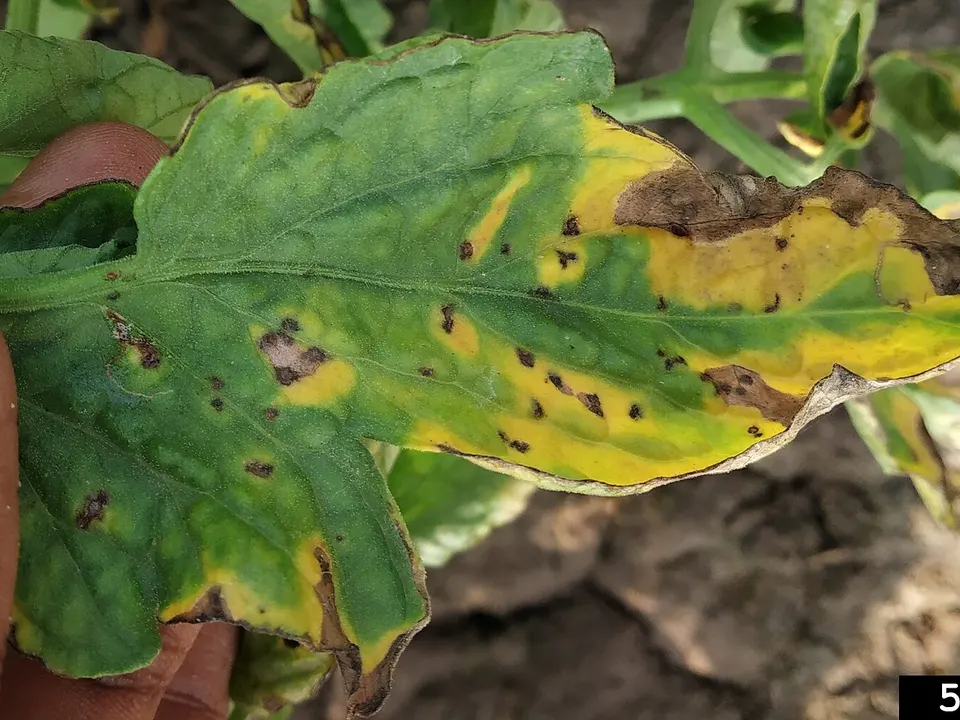
Quick check: what do you see?
Start with the row that matches your plant best, then jump to that cause for how to confirm it and fix it.
| What you see | Most likely cause |
|---|---|
| Small brown spots with yellowish edges, sometimes with rings or tiny black dots | Fungal leaf spot Most common |
| Dark, water-soaked spots of similar size, often with a yellow halo | Bacterial leaf spot |
| Leaf tips turn yellow, then tan, then dark brown; or shade-tree leaves blotched brown after a wet spring | Anthracnose |
| Plumeria: yellow-orange powder under the leaves, yellow then brown spots on top | Plumeria rust |
| Scorched patches on leaves facing a sunny window, or after moving a plant outside | Sun scorch |
| Brown patches in the middle of leaves after cold or a sudden temperature drop | Cold damage |
Compare the symptoms
Illustrations, not photos: drawn to show the typical pattern of each cause. Free to reuse.
The 6 causes, and how to fix each
1. Fungal leaf spot
Most commonSigns
- Small brown spots with yellowish edges, sometimes with rings like a target and tiny black dots in the dead tissue.
- Spots can join up and kill the whole leaf.
- On trees and shrubs, spots range from a pinhead to the whole leaf and can be brown, black, tan or reddish, sometimes with a red or purple border.
How to confirm
- Look for the tiny black dots with a magnifying lens: they are the fungus’s spore-making bodies.
- Outdoors, it shows up most after cool, wet weather early in the season, and seldom after a warm, dry spring.
How to fix it
- Pick off spotted leaves and destroy them.
- Keep water off the leaves: stop misting and water at the soil.
- Give the plant space so air moves around it, and let the soil dry a little between waterings.
- Outdoors, rake up and destroy fallen leaves in the fall: the fungus survives the winter in them.
- Houseplants: if spots keep spreading, Clemson lists copper soap and other fungicides. Follow the label and spray outdoors in the shade.
- Trees and shrubs: spraying after spots appear is usually a waste of money. Fungicides only protect leaves before infection, from bud break, and are worth it mainly for stressed trees.
Based on: Clemson Cooperative Extension [1], University of Connecticut [2], University of Illinois Extension [4]
2. Bacterial leaf spot
CommonSigns
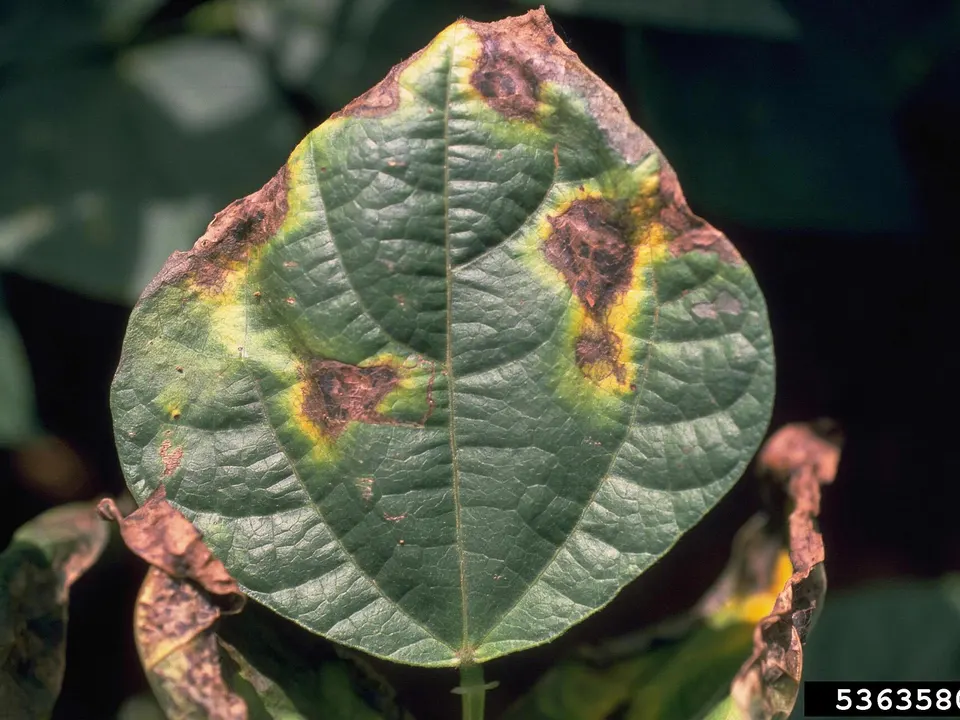
- Water-soaked spots of similar size, often with a yellow halo, sometimes with sticky ooze.
- In wet conditions the spots grow and merge; in drier conditions they dry to reddish brown with a speckled look.
How to confirm
- The spots look wet or greasy when they first appear, rather than dry and papery.
How to fix it
- Remove every spotted leaf.
- Don’t spray or splash water on the leaves, keep the plant warm, and don’t crowd plants together.
- Clemson lists copper soap products for bacterial leaf spot on houseplants. Follow the label.
Based on: Clemson Cooperative Extension [1]
3. Anthracnose
CommonSigns
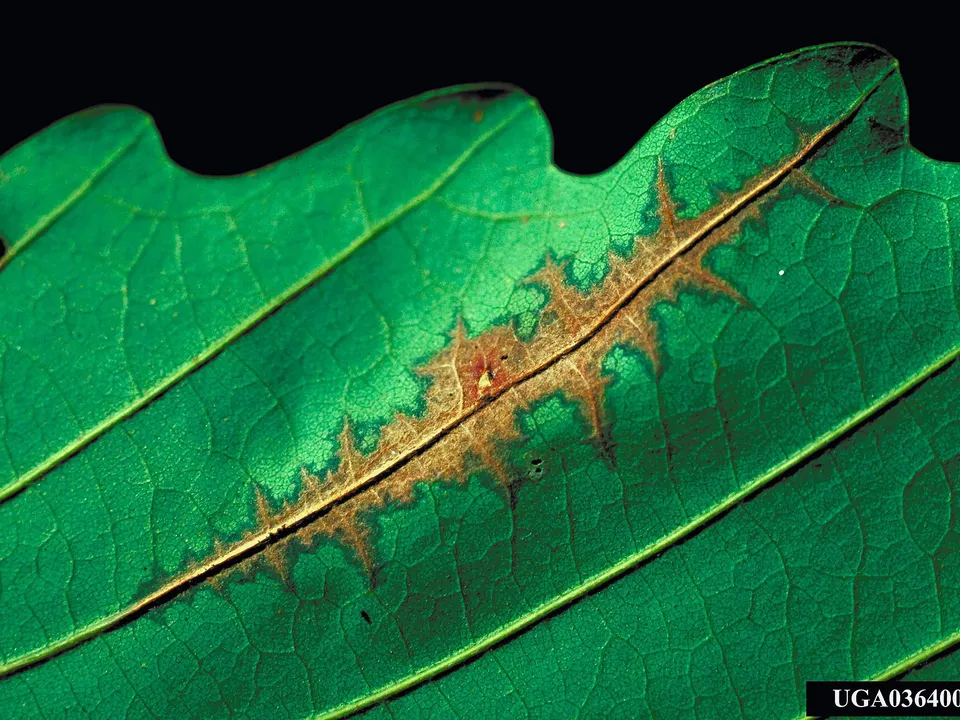
- Houseplants: leaf tips turn yellow, then tan, then dark brown, and the browning can spread around the leaf until it dies. Wounds help the fungus get in.
- Shade trees (oak, maple, sycamore, ash, walnut, hickory and horse chestnut): brown or black blotches, twisted leaves and early leaf drop.
How to confirm
- On trees, it follows a cool, wet spring, and the tree usually puts out new leaves later in the season.
How to fix it
- Houseplants: pick off and destroy infected leaves, and stop misting. Copper soap or other listed fungicides can be used after removing them.
- Trees: rake up and destroy fallen leaves. Usually no spraying is needed: the tree regrows its leaves, with no long-term damage.
Based on: Clemson Cooperative Extension [1], University of Connecticut [2]
4. Plumeria rust
CommonSigns
- On plumeria, the undersides of the leaves get many tiny, raised, powdery yellow-orange pustules.
- The top of the leaf shows yellow flecks opposite them. As they grow and merge, they become sunken, angular gray to brown spots.
- Badly infected leaves dry, curl and drop, sometimes within two months of the spring leaf flush.
How to confirm
- Turn the leaf over: the orange powder rubs off easily.
- The rust only infects leaves, not stems or flowers. On plumeria it is worse in warm, humid spots.
How to fix it
- Pick up and destroy fallen leaves, and remove badly infected leaves early in the season.
- Space plants widely and keep tall weeds down, so leaves dry quickly after rain.
- If you need a fungicide, use one labeled for plumeria rust, follow the label, and switch between products that work in different ways.
- When you buy, choose resistant types: the University of Hawaiʻi rates Plumeria stenopetala and P. caracasana highly resistant, while all P. rubra types are highly susceptible.
Based on: University of Hawaiʻi at Mānoa [3]
5. Sun scorch
CommonSigns
- Scorched patches on the leaves that get the most sun.
- Often appears after a houseplant moves into direct sun or outdoors for the summer.
How to confirm
- The damage is on the side of the plant facing the light, and it started after the plant got stronger sun.
How to fix it
- Move the plant out of direct sun, or to a spot with less sun.
- When moving houseplants outside for the summer, get them used to brighter light gradually.
Based on: University of Illinois Extension [4], Clemson Cooperative Extension [5], University of Wisconsin–Madison Division of Extension [6]
6. Cold damage
Less commonSigns
- Scattered brown patches, usually in the middle of the leaf, after the plant was cold or went quickly from very warm to cooler air.
How to confirm
- The plant was somewhere cold, or was moved suddenly from a very warm spot to a cooler one.
How to fix it
- Move the plant somewhere warmer, away from heating and air-conditioning vents.
- Avoid sudden big temperature changes.
Based on: University of Wisconsin–Madison Division of Extension [7], Clemson Cooperative Extension [5]
Brown spots on a specific plant
Each plant has its own common causes. If yours is listed, its guide goes into more detail.
Look-alikes: what it might not be
Pale spots from cold water
Cold water splashed on leaves can leave white or straw-colored spots or patches. They are pale rather than brown, and appear where water landed. Water the soil, not the leaves, with room-temperature water. [1]
Corky bumps under the leaf (oedema)
Rough, corky swellings on leaf stalks and the undersides of leaves are oedema, not a leaf spot. It comes from soil that stays too wet, poor light and low temperatures, and is most common on succulents in winter. Give more light and water less; the affected leaves won’t recover. [1]
How to prevent it
- Water the soil, not the leaves.
- Space plants so air can move between them.
- Remove spotted leaves as soon as you see them, and rake up fallen leaves outdoors.
- Don’t move plants straight from shade into strong sun.
- Keep houseplants away from cold drafts and heating or cooling vents.
- When buying, choose disease-resistant varieties where they exist.
Questions people ask
Why do my houseplant leaves have brown spots?
Indoors, a fungal or bacterial leaf spot is likely when spots spread on plants whose leaves stay wet. Improve air circulation, remove the infected leaves, and let the soil dry between waterings. Patches on the sunny side point to sun scorch, and patches after the plant got cold to cold damage. [4, 1, 7]
Why does my plumeria have brown spots on its leaves?
Usually plumeria rust, a fungus. Look under the leaves for yellow-orange powder. The yellow flecks on top turn into brown, angular spots, and badly infected leaves drop early. Remove fallen and badly infected leaves, space plants for airflow, and choose resistant types. [3]
What causes brown spots on a plant’s stem?
A ring of brown or black tissue around the stem at or near the soil, with wilting leaves, is a sign of stem rot. It comes from overwatering and fungi in the soil. Cut out a few rotten roots and repot in fresh, sterile mix; if most of the roots are dead, the plant is unlikely to recover. [1]
What causes black spots on plant leaves?
Dark, water-soaked spots with a yellow halo are usually bacterial leaf spot. Tiny black dots inside brown spots are the spore-making bodies of a fungal leaf spot. On shade trees, anthracnose can cause brown or black blotches. [1, 2]
Sources
Facts on this page were checked against these sources on November 10, 2026. The wording and illustrations are our own.
- Houseplant Diseases & Disorders (HGIC 2251). Clemson Cooperative Extension, Home & Garden Information Center. Updated Feb 28, 2025.
- Leaf Spot Disease of Trees and Shrubs. University of Connecticut, Integrated Pest Management. Updated 2011.
- Plumeria Rust (PD-61). University of Hawaiʻi at Mānoa, College of Tropical Agriculture and Human Resources. Jan 2009.
- Keep houseplants happy with simple solutions. University of Illinois Extension. Feb 22, 2021.
- Peace Lily (HGIC 1512). Clemson Cooperative Extension, Home & Garden Information Center. Revised Feb 15, 2022.
- Swiss-Cheese Plant, Monstera deliciosa. University of Wisconsin–Madison Division of Extension, Wisconsin Horticulture. Revised Oct 2026.
- Pothos, Epipremnum aureum. University of Wisconsin–Madison Division of Extension, Wisconsin Horticulture.
Spotted a mistake? Report an error and we'll check it against the sources and update the page.