Dieffenbachia (dumb cane) care: light, water and keeping it full
Short answer
Dieffenbachia, or dumb cane, grows best in bright, filtered light and tolerates low light, though it then grows slowly. Water thoroughly, then let the top inch of soil dry. Keep it at 60–75 °F, away from cold and big temperature swings, and feed it from March to September. All parts are poisonous: the sap burns the mouth and throat, so keep it away from children and pets.[1, 2, 3]
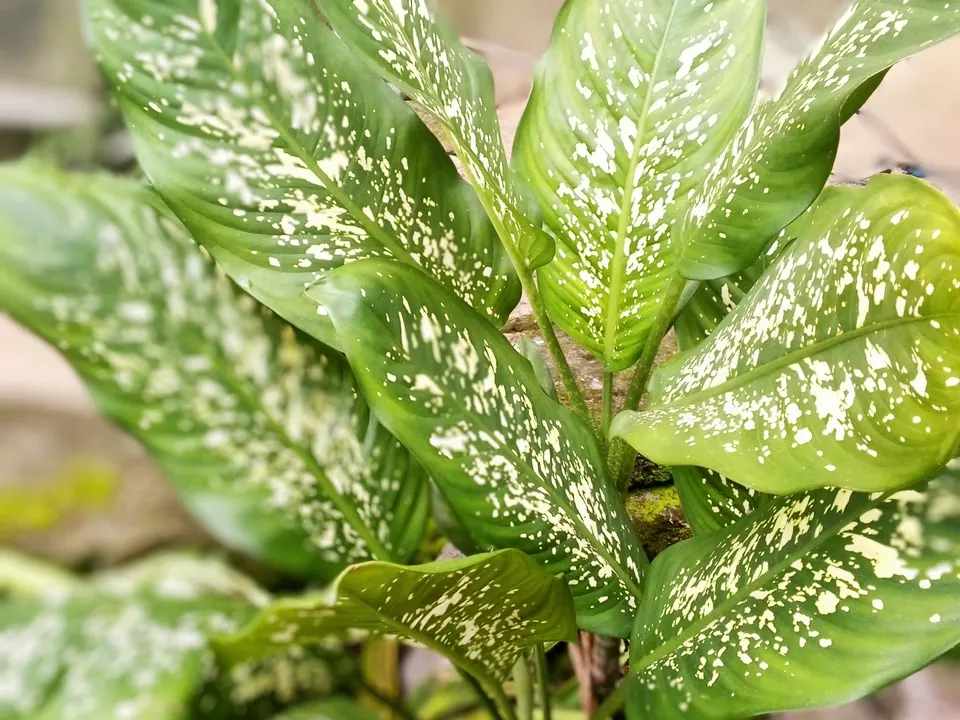
Dieffenbachia care at a glance
| Light | Bright, filtered light; direct sun only in winter |
|---|---|
| Watering | Thoroughly, when the top inch is dry |
| Soil and pots | Any well-drained potting mix |
| Humidity | Ordinary home humidity is fine |
| Temperature | 60–75 °F; avoid cold and sudden changes |
| Feeding | March to September |
| Repotting | In early spring |
| Pruning a bare, leggy plant | Cut tall, bare canes back to about 6 inches |
| Propagation | Cane or tip cuttings, or air layering |
| How big it gets | Most grow 3–6 feet tall |
| Pets | Yes: to people, cats and dogs |
Light
- Give it bright, filtered light in spring, summer and fall. In winter, bright light or even direct sun is best. [1]
- It tolerates low light, but grows slowly or barely at all there. [1, 2]
Watering
- Water thoroughly, then let the soil dry to the touch to a depth of about one inch. [1, 2]
- It is often overwatered, which quickly rots the roots and the base of the canes. [1, 2]
Soil and pots
- It grows well in most well-drained container mixes, including regular potting soil. [1, 2]
- A mix that drains slowly is a common cause of root rot. [1]
Humidity
- It grows well in low humidity, so ordinary indoor air suits it. [2]
Temperature
- Normal warm household temperatures suit it; 60–75 °F is ideal. [1]
- Protect it from cold and from big temperature changes. [1]
Feeding
- Feed from March through September with a foliage houseplant fertilizer: a liquid at half strength every two to four weeks, or a time-release fertilizer as the label directs. [1]
- Too much fertilizer burns the leaf edges; too little gives yellowing, smaller leaves and stunted growth. [1]
Repotting
- Repot in early spring. [1]
Pruning a bare, leggy plant
- Lower leaves drop naturally as it grows, leaving bare, trunk-like canes. Remove lower leaves when they turn yellow. [1, 2]
- If the canes get too long and bare, cut them back to about 6 inches tall: the plant regrows below the cut. [1]
- Wear gloves: the sap irritates skin and is harmful in open cuts. [1, 2]
Propagation
- Propagate in spring or early summer from cane cuttings, stem tip cuttings or by air layering. [1]
- The cut-off top of a bare cane roots in sand or water. [2]
How big it gets
- Most grow 3–6 feet tall and 1–3 feet wide, with leaves up to 18 inches long and 12 inches wide. [1]
- It grows fast in ideal conditions and hardly at all in low light. [1]
Is dieffenbachia poisonous?
- All parts contain needle-like crystals. Chewing it causes numbing and burning of the mouth and throat and can make it hard to speak; the throat can swell, so get medical help right away. [1]
- Sap in the eyes is painful, and some people get a skin rash from it. [1]
- The ASPCA lists it as toxic to dogs and cats (insoluble calcium oxalates): signs include intense burning of the mouth, drooling, vomiting and trouble swallowing. [3]
- Keep it away from children and pets. If a pet chews it, call your vet or the ASPCA Animal Poison Control Center, (888) 426-4435. [1, 3]
Compare with other plants in our pet-safe houseplant checker.
Dieffenbachia varieties
| Variety | What it looks like |
|---|---|
| 'Tiki' | One of the largest at maturity; silver leaves mottled green and white. Tolerates low light. [1] |
| 'Paradise' | Soft yellow leaves speckled green; upright, and nearly twice as tall as ‘Camille’ when mature. [1] |
| 'Hilo' | A large type with pointed leaves and bold white veins. [1] |
| 'Tropic Snow' | Wide-spreading dark green leaves blotched creamy white along the veins; copes with lower light than most. [1] |
| 'Camille' | Creamy yellow leaves edged in rich green; bushy and full. [1] |
| 'Compacta' | Compact and very full; cream leaves mottled green. Good for small spaces. [1] |
| 'Snow Queen' | Pale lemon to creamy gold leaves with white veins and dark green edges. [1] |
| 'Rudolph Roehrs' | Creamy yellow leaves with white spots and dark green veins and edges. [1] |
Common dieffenbachia problems
| What you see | Usual cause |
|---|---|
| Yellow, falling lower leaves; bare canes | Normal as it grows. Cut tall, bare canes back to about 6 inches. [1, 2] |
| Mushy roots or cane base | Overwatering, or a mix that drains slowly. [1, 2] |
| Brown leaf edges | Too much fertilizer. [1] |
| Yellowing, smaller leaves and slow growth | Too little fertilizer. [1] |
| Sticky leaves | Mealybugs or aphids (honeydew); also check for mites. [1] |
Not sure what's wrong? Use the plant doctor to match what you see to a cause.
Questions people ask
Is dieffenbachia (dumb cane) poisonous?
Yes. Chewing any part burns the mouth and throat and can make it hard to speak, and the throat can swell. It is toxic to cats and dogs too. Keep it out of reach, and get medical or vet help if someone chews it. [1, 3]
How big does a dieffenbachia get?
Most reach 3–6 feet tall and 1–3 feet wide, with leaves up to 18 inches long. ‘Tiki’ is one of the largest; ‘Compacta’ stays small and full. [1]
What do I do with a tall, leggy dieffenbachia?
Cut the bare canes back to about 6 inches: new growth sprouts below the cut. You can root the cut top in sand or water to make a new plant. Wear gloves, because the sap irritates skin. [1, 2]
How often should I water a dieffenbachia?
Water thoroughly, then wait until the top inch of soil is dry before watering again. Overwatering is a common mistake: it quickly rots the roots and canes. [1, 2]
Sources
Facts on this page were checked against these sources on November 10, 2026. The wording is our own.
- Dieffenbachia (HGIC 1503). Clemson Cooperative Extension, Home & Garden Information Center. Revised Sep 16, 2015.
- Dieffenbachia. University of Illinois Extension, Houseplants.
- Toxic and Non-Toxic Plants: Dieffenbachia. ASPCA Animal Poison Control Center.
Spotted a mistake? Report an error and we'll check it against the sources and update the page.