Succulent care indoors: light, watering, soil and repotting
Short answer
Indoor succulents need at least six to eight hours of bright light a day, from a sunny window or a grow light. Water deeply only when the soil is completely dry, often every two to three weeks and much less in winter. Use a gritty, fast-draining mix in a pot with a drainage hole, feed very little, and repot only rarely. Some, such as jade and aloe, are toxic to pets.[1, 2, 4, 5]
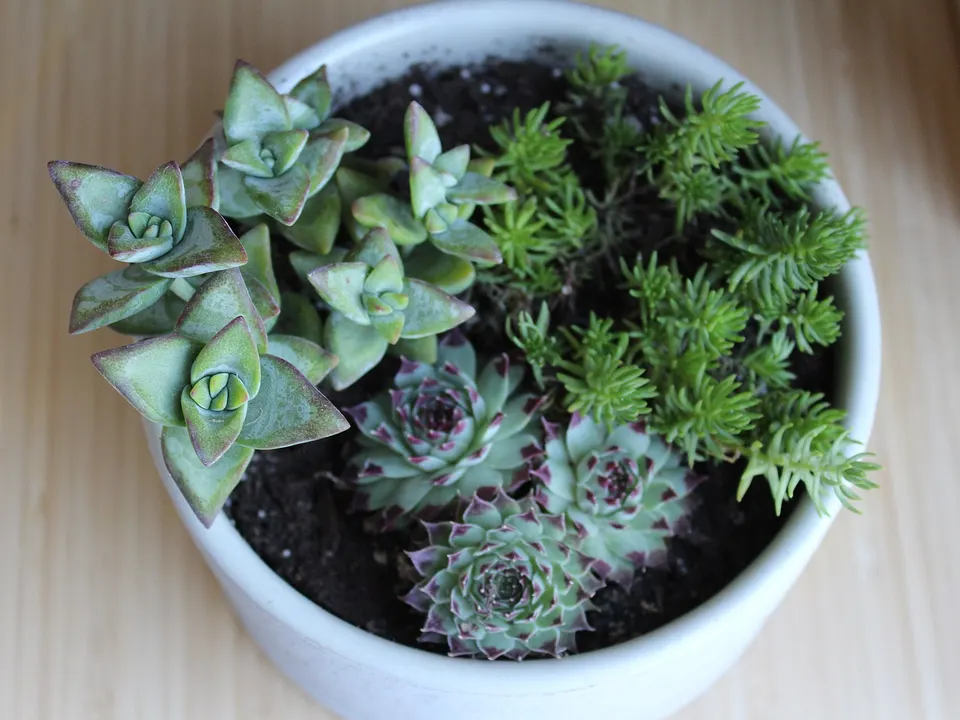
Succulent care at a glance
| Light requirements | At least 6–8 hours of bright light |
|---|---|
| How often to water | Only when the soil is completely dry |
| Soil for succulents | Gritty, fast-draining: 1 part organic to 2 parts mineral |
| Pots and repotting | Drainage hole; repot rarely, into a snug pot |
| Temperature | 55–75 °F, cooler at night |
| Humidity and air | Dry home air is fine; give them airflow |
| Fertilizer | Very little, in spring and summer only |
| Propagation | Offsets, stem cuttings or leaf cuttings |
| Are succulents safe for pets? | Some are, some aren’t: check the type |
Light requirements
- Most succulents need at least six to eight hours of bright light a day; lack of light is the biggest challenge indoors. [1, 2]
- If a sunny window isn’t enough, use high-output, full-spectrum LED or fluorescent grow lights. [1, 2]
- Turn the pots often: succulents grow toward the light. In too little light they stretch and turn pale. [1, 2]
- Moving them outside for summer? Start in indirect light and move them into sun gradually, because strong sun can burn them. [1, 2]
How often to water
- Water deeply until water runs out of the drainage holes, then let the soil dry out completely before watering again. [1, 2]
- That is often every two to three weeks, but it depends on light, soil, pot, temperature and humidity. Check that the soil is dry several inches down. [1, 2]
- In winter, when they rest, water much less: perhaps only a couple of times. [2]
- Overwatering is the biggest mistake. Never leave water standing in a saucer or decorative pot for more than a few hours. [1, 2]
Soil for succulents
- Use a bagged cactus and succulent mix, or make your own: 1 part potting soil, bark, compost or coir to 2 parts perlite, coarse sand, pumice or fine gravel. [1, 2]
- Ordinary potting soil holds too much water and risks root rot. [1]
Pots and repotting
- Every pot needs a drainage hole; gravel in the bottom is no substitute. Clay and terracotta are ideal because they let the soil dry faster. [1, 2]
- Succulents rarely need repotting and often do better in slightly small pots. Choose one just big enough; avoid oversized pots. [1]
- To repot, remove loose soil from the roots, set the plant in the new pot, fill with well-drained mix and water lightly. Use thick gloves or folded paper for spiny plants. [1]
- Repot while the plant is actively growing, typically in spring or early summer. [3]
Temperature
- Ideal is 55–75 °F with cooler nights; most tolerate about 45–85 °F. [1]
Humidity and air
- The low humidity of most homes suits them; indoor air is rarely too dry. [1]
- Good air circulation helps the soil dry and discourages mealybugs and spider mites. A small fan helps crowded plants. [1]
Fertilizer
- Iowa State: feed in spring and summer with an all-purpose fertilizer at one-half to one-quarter of the label rate, or a cactus and succulent fertilizer, about every 3–4 waterings. [1]
- Illinois: most need no regular feeding; once a year in late spring or summer, at one-quarter to one-half strength, is enough. [2]
- Both agree: don’t feed in winter. [1, 2]
Propagation
- Depending on the type, propagate from offsets (pups), stem cuttings or leaf cuttings. [1, 2]
- Let a cutting’s cut end dry and callus for about a week, then lay it on or set it in moist soil. Give it at least a month to root before potting it up. [2]
Are succulents safe for pets?
- Toxic to dogs, cats and horses (ASPCA): jade plant (vomiting, depression, incoordination) and aloe vera (vomiting, lethargy, diarrhea). [4, 5]
- Non-toxic to dogs, cats and horses (ASPCA): hens and chickens (Echeveria elegans), zebra haworthia and burro’s tail. [6, 7, 8]
- If you aren’t sure what your succulent is, keep it away from pets. If a pet eats a toxic one, call your vet or the ASPCA Animal Poison Control Center, (888) 426-4435. [4, 5]
Compare with other plants in our pet-safe houseplant checker.
Common succulent problems
| What you see | Usual cause |
|---|---|
| Tall, stretched, pale growth | Too little light. [1, 2] |
| Yellow leaves, soft stems, collapsing plant | Too much water. [1] |
| Wrinkled, shriveled lower leaves | Too little water. [1] |
| Scorched leaves after moving outside | Sunburn: move plants into sun gradually. [1, 2] |
| White cottony clumps or small bumps | Mealybugs or scale. Swab with rubbing alcohol; neem oil or insecticidal soap also work. [2] |
| Dry lowest leaves | Normal. They can be removed. [2] |
Not sure what's wrong? Use the plant doctor to match what you see to a cause.
Questions people ask
How often should I water a succulent?
Only when the soil is completely dry several inches down, often every two to three weeks indoors, and much less in winter. Water deeply until it drains, and never leave the pot standing in water. [1, 2]
What soil do succulents need?
A gritty, fast-draining mix: a bagged cactus and succulent mix, or 1 part potting soil (or coir) to 2 parts perlite, coarse sand or pumice. Ordinary potting soil stays too wet. [1, 2]
When should I repot a succulent?
Rarely: they often do better in slightly small pots. Repot in spring or early summer, into a pot just big enough with a drainage hole, and water lightly afterward. [1, 3]
How much light do succulents need indoors?
At least six to eight hours of bright light a day. If a sunny window isn’t enough and they stretch, add a full-spectrum LED or fluorescent grow light. [1, 2]
Do succulents need fertilizer?
Very little. Feed only in spring and summer at a quarter to half strength: Iowa State suggests every three or four waterings, while Illinois says once a year is enough. Never feed in winter. [1, 2]
Sources
Facts on this page were checked against these sources on November 10, 2026. The wording is our own.
- Growing Succulents Indoors. Iowa State University Extension and Outreach, Yard and Garden. Last reviewed Dec 2024.
- Did you forget to water your plants? Try low-maintenance succulents. University of Illinois Extension. Jan 8, 2024.
- Repotting. University of Illinois Extension, Houseplants.
- Toxic and Non-Toxic Plants: Jade Plant. ASPCA Animal Poison Control Center.
- Toxic and Non-Toxic Plants: Aloe. ASPCA Animal Poison Control Center.
- Toxic and Non-Toxic Plants: Hens and Chickens. ASPCA Animal Poison Control Center.
- Toxic and Non-Toxic Plants: Zebra Haworthia. ASPCA Animal Poison Control Center.
- Toxic and Non-Toxic Plants: Burro’s Tail. ASPCA Animal Poison Control Center.
Spotted a mistake? Report an error and we'll check it against the sources and update the page.