Christmas cactus care: how to get it to bloom every year
Short answer
Grow Christmas cactus in light shade or bright, indirect light, in a well-drained mix, and water when the mix feels dry. To make it bloom, give it long, uninterrupted nights (12–14 hours of darkness) and cool nights of about 55–65 °F for 5–6 weeks from mid-September. Keep the soil evenly moist once buds form. It’s non-toxic to cats and dogs.[1, 2, 3]
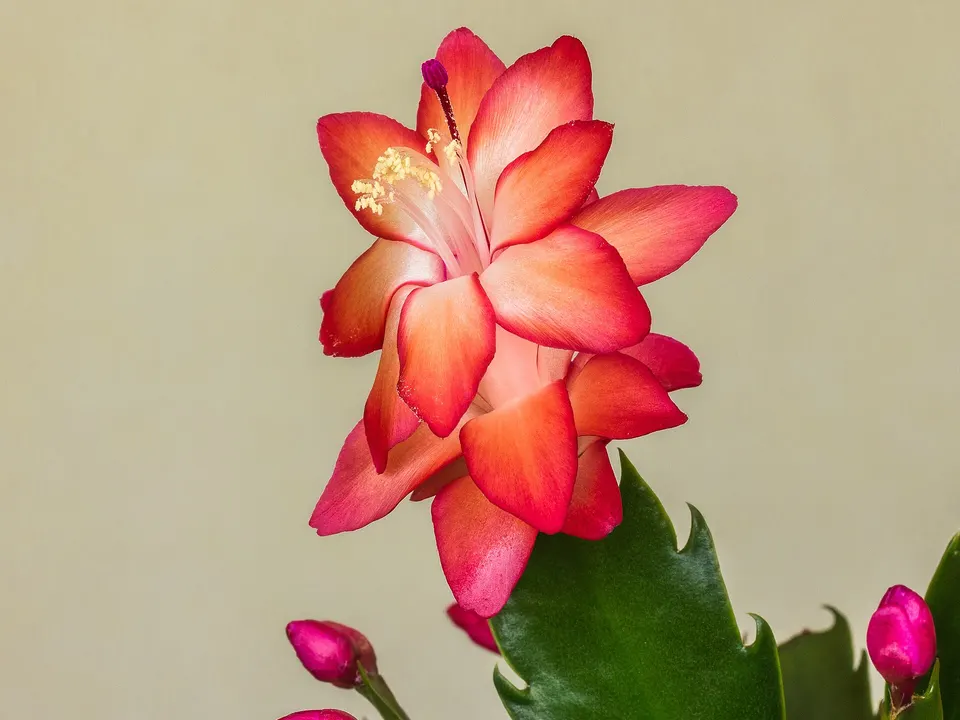
Christmas cactus care at a glance
| Light | Light shade; bright, indirect light while blooming |
|---|---|
| Watering | When the mix is dry; evenly moist once buds form |
| Soil and pots | Well-drained, airy mix |
| Temperature | 70–80 °F in summer; cool nights in fall |
| Feeding | Monthly from late winter to late summer |
| Getting it to bloom | Long dark nights and cool temperatures in fall |
| Repotting | About every three years, in spring |
| Propagation | Cuttings of 3–5 segments in May or June |
| Christmas, Thanksgiving or Easter cactus? | Check the stem edges and pollen color |
| Pets | No: non-toxic to dogs, cats and horses |
Light
- It grows best in light shade. [1]
- Strong summer sun can turn the stems pale and yellow, or sunburn them. [1, 2]
- While it’s blooming, give it bright, indirect light. [2]
Watering
- Water when the mix is dry to the touch, and never leave water standing in the saucer. [1, 2]
- Once buds have formed, keep the mix evenly moist: letting it dry out can make the buds drop. [1, 2]
- After flowering, water a little less until new growth appears, then go back to normal. [2]
- Overwatering kills the roots; the stems then wilt, shrivel and turn dull gray-green. [2]
Soil and pots
- Use a well-drained, airy mix: about 60–80% potting soil with 20–40% perlite, or a cactus potting mix. [1, 2]
Temperature
- It grows best at 70–80 °F in spring and summer. [1]
- In fall, keep it at about 60–68 °F. Nights of 50–59 °F set buds whatever the day length. [1]
- Below 50 °F, buds may drop. Once buds are set, keep it below 90 °F. [1, 2]
- While it’s in bloom, about 70 °F by day and 55–65 °F at night suits it. [2]
Feeding
- Feed monthly from when new growth starts in late winter or spring, with a half-strength soluble fertilizer such as 20-10-20 or 20-20-20. [1, 2]
- Stop feeding in late summer. [1, 2]
- Clemson also suggests Epsom salts (1 teaspoon per gallon of water) once a month in the growing season, in a different week from the fertilizer. [1]
Getting it to bloom
- From about mid-September, give it long nights: 12–14 or more hours of continuous darkness a day for 5–6 weeks. [1, 2]
- Even 2 hours of light at night, from lamps, streetlights or car headlights, can stop buds forming. A room with no lights on at night works well. [1, 2]
- Cool nights of about 55–65 °F help; if it’s kept too warm, especially at night, it may not bloom. [2]
- Buds usually appear in 3–4 weeks. Once they’re set, day length no longer matters. [1, 2]
- Pinch the stems back in early June to make it branch and carry more flowers. [1, 2]
Repotting
- Repot only about every three years, ideally in spring. [1, 2]
- It flowers best when kept somewhat pot-bound. [1, 2]
Propagation
- Take cuttings of 3–5 stem segments in May or June. [1]
- They root in about three to eight weeks. [1]
Christmas, Thanksgiving or Easter cactus?
- Thanksgiving cactus has 2–4 pointed teeth along each stem segment; Christmas cactus has smoother, rounded edges. [1, 2]
- Thanksgiving cactus has yellow anthers (the pollen-bearing tips); Christmas cactus has purplish-brown ones. [1, 2]
- Thanksgiving cactus blooms from late November to late December, Christmas cactus from late December to March, and Easter cactus, with star-shaped flowers, from March to May. [2]
- Most plants sold as “Christmas cactus” are really Thanksgiving cacti. Both get the same care. [1, 2]
Is Christmas cactus toxic to pets?
- The ASPCA lists Christmas cactus as non-toxic to dogs, cats and horses. [3]
Compare with other plants in our pet-safe houseplant checker.
Christmas cactus varieties
| Variety | What it looks like |
|---|---|
| Christmas cactus | Rounded, scalloped stem edges and purplish-brown anthers; blooms late December to March. [1, 2] |
| Thanksgiving cactus | Pointed teeth on the stem edges and yellow anthers; blooms late November to late December. [1, 2] |
| Easter cactus | Rounded stem edges and star-shaped flowers, often pink or red; blooms in spring. [1, 2] |
Common Christmas cactus problems
| What you see | Usual cause |
|---|---|
| Buds falling off | A sudden change in temperature or light, drafts, too warm or below 50 °F, the mix drying out, low humidity, or too many buds. [1, 2] |
| No flowers | Lights at night interrupting the dark period, or nights kept too warm. [1, 2] |
| Wilted, shriveled, gray-green stems | Overwatering has killed roots. [2] |
| Pale or yellow stems in summer | Too much sun. [1, 2] |
| Pests | Mealybugs, scale, spider mites, aphids, and fungus gnats in soggy mix. [1, 2] |
Not sure what's wrong? Use the plant doctor to match what you see to a cause.
Questions people ask
Why won’t my Christmas cactus bloom?
Usually its nights aren’t long, dark or cool enough. From mid-September give it 12–14 hours of uninterrupted darkness and nights around 55–65 °F for 5–6 weeks. [1, 2]
Why are the buds falling off my Christmas cactus?
Bud drop follows sudden changes in temperature or light, drafts, temperatures that are too warm or below 50 °F, or the mix drying out while it’s in bud. [1, 2]
Is Christmas cactus toxic to cats and dogs?
No. The ASPCA lists it as non-toxic to dogs, cats and horses. [3]
How do I tell a Christmas cactus from a Thanksgiving cactus?
Look at the stem segments: Thanksgiving cactus has pointed teeth along the edges, Christmas cactus has rounded edges. The anthers are yellow on Thanksgiving cactus and purplish-brown on Christmas cactus. [1, 2]
What soil is best for a Christmas cactus?
A well-drained, airy mix, such as 60–80% potting soil with 20–40% perlite, or a cactus potting mix. [1, 2]
Sources
Facts on this page were checked against these sources on November 6, 2026. The wording is our own.
- Thanksgiving & Christmas Cacti (HGIC 1554). Clemson Cooperative Extension, Home & Garden Information Center. Updated Nov 29, 2018.
- How to identify and care for holiday cacti and get them to rebloom. University of Illinois Extension, Good Growing. Dec 9, 2022.
- Toxic and Non-Toxic Plants: Christmas Cactus. ASPCA Animal Poison Control Center.
Spotted a mistake? Report an error and we'll check it against the sources and update the page.