Why are my pothos leaves turning yellow?
Short answer
The most common cause is overwatering: soil that stays wet leads to yellow leaves and, if it continues, root rot. Other causes are too much direct sun, underwatering, low fertility, too much fertilizer, cold drafts and sap-sucking pests. One or two yellow leaves at the base of an otherwise healthy vine is often just old leaves being shed, which is normal.
Quick check: what do you see?
Start with the row that matches your plant best, then jump to that cause for how to confirm it and fix it.
| What you see | Most likely cause |
|---|---|
| Several leaves yellowing, soil still damp days after watering | Overwatering and root rot Most common |
| Only one or two of the oldest leaves, plant otherwise growing well | Normal leaf aging |
| Pale, bleached or scorched patches on leaves facing a sunny window | Too much direct sun |
| Limp, drooping vines; soil bone dry; yellowing with crispy edges | Underwatering |
| Whole plant pale and slow-growing; not fed in a long time | Low fertility (hungry plant) |
| Brown or black tips and edges with yellowing, after regular feeding | Too much fertilizer |
| Brown patches in the middle of leaves after a cold spell or near a vent | Cold or drafts |
| Fine pale speckles, a faded look, webbing, or white cottony clumps | Pests: spider mites, mealybugs or scale |
Compare the symptoms
Illustrations, not photos: drawn to show the typical pattern of each cause. Free to reuse.
- Overwatering and root rot
- Normal leaf aging
- Too much direct sun
- Underwatering
- Low fertility (hungry plant)
- Too much fertilizer
- Cold or drafts
- Pests: spider mites, mealybugs or scale
The 8 causes, and how to fix each
1. Overwatering and root rot
Most commonSigns
- Several leaves turn yellow, not just the odd old one.
- The soil is still damp several days after watering, or the pot never seems to dry out.
- Leaf tips or edges may blacken as well.
How to confirm
- Push a finger 1–2 inches into the soil. If it is wet, this cause is likely.
- Slide the plant out of its pot and look at the roots. Roots that are brown, or that have mostly disappeared, point to root rot.
- Check that the pot has a drainage hole and is not standing in a saucer of water.
How to fix it
- Stop watering until the soil has dried completely, then water thoroughly and let the excess drain away.
- If roots are brown, cut away the damaged roots, then repot into fresh, well-draining potting mix in a pot with drainage holes. Wear gloves: pothos sap can irritate skin.
- After repotting, water lightly. Extra water right after repotting adds stress.
- If most roots are gone, take stem cuttings with at least one node from healthy vines and root them in water or soil as a backup.
- Snip off leaves that are fully yellow to tidy the plant.
Based on: Clemson Cooperative Extension [1], Penn State Extension [2], University of Wisconsin–Madison Division of Extension [3]
2. Normal leaf aging
CommonSigns
- Only one or two leaves at a time, always the oldest ones nearest the soil or the base of a vine.
- The rest of the plant looks healthy and keeps putting out new leaves.
How to confirm
- New growth is green and healthy, the soil dries out normally between waterings, and no other symptoms show up.
How to fix it
- No treatment needed. Pull or snip off the yellow leaf.
- Pothos naturally drops its older leaves, so long vines end up with most of their leaves near the tips. Prune vines selectively to keep them a manageable length and encourage new growth.
Based on: University of Wisconsin–Madison Division of Extension [3]
3. Too much direct sun
CommonSigns
- Yellowing or bleached, washed-out patches on the leaves that face the window.
- Dry brown scorch spots or brown leaf tips on the sunny side.
How to confirm
- Sunlight falls directly on the leaves for part of the day.
- The leaves on the shaded side of the plant look normal.
How to fix it
- Move the plant back from the window or filter the light with a sheer curtain. Pothos prefers bright, indirect light.
- Remove badly scorched leaves; new leaves will grow in normally.
Based on: Penn State Extension [2], Clemson Cooperative Extension [1]
4. Underwatering
CommonSigns
- Vines and leaves droop and look limp.
- The soil is bone dry.
- Yellowing with darkened leaf edges or tips.
How to confirm
- The soil is dry well below the surface, and the pot feels light when you lift it.
- Drooping leaves recover after a good watering. Penn State notes this drooping is usually temporary.
How to fix it
- Water thoroughly until water runs out of the drainage hole, so it reaches all of the roots.
- From then on, water when the soil has dried, rather than on a fixed schedule. Pothos copes better with being slightly too dry than too wet.
Based on: Penn State Extension [2], Clemson Cooperative Extension [1], University of Wisconsin–Madison Division of Extension [3]
5. Low fertility (hungry plant)
Less commonSigns
- The whole plant looks pale or yellow-green rather than just a few leaves.
- Growth is slow, and new leaves are small.
How to confirm
- The plant has not been fed for months, or has been in the same potting mix for a long time.
- Watering and light are fine, which rules out the more common causes.
How to fix it
- Feed with a balanced houseplant fertilizer during spring and summer, following the label. Extension advice ranges from every other month (Clemson) to more frequent feeding (Penn State), so start light.
- Repot into fresh potting mix in spring if it has been more than a year or two.
Based on: Clemson Cooperative Extension [1], Penn State Extension [2]
6. Too much fertilizer
Less commonSigns
- Leaf tips and edges turn brown or black, with yellowing just inside the dead edge.
- Usually appears after regular or heavy feeding.
How to confirm
- You fertilize often or use more than the label rate, and watering and light are otherwise fine.
How to fix it
- Stop fertilizing for now. When you start again, use the label rate or less.
- Repot into fresh potting mix if the plant has been fed heavily for a long time, since fertilizer salts build up in old soil.
- Trim off the browned tips with clean scissors.
Based on: University of Wisconsin–Madison Division of Extension [3]
7. Cold or drafts
Less commonSigns
- Scattered brown or yellow-brown patches, usually near the center of the leaf.
- Appears after a cold night, a move, or time near a door, a cold window or an air-conditioning or heating vent.
How to confirm
- The plant sits on a winter windowsill or in the path of a vent, or the room drops well below 60 °F at night.
How to fix it
- Move the plant somewhere with steady temperatures: about 60–70 °F at night and 70–85 °F during the day.
- Keep it away from air-conditioning and heating vents, and off windowsills in winter.
- Remove badly damaged leaves once new growth appears.
Based on: University of Wisconsin–Madison Division of Extension [3], Clemson Cooperative Extension [1]
8. Pests: spider mites, mealybugs or scale
Less commonSigns
- Spider mites: fine, pale speckling on the upper side of leaves and an overall faded look, later yellowing; fine webbing in heavy infestations.
- Mealybugs: white, cottony clumps in the joints where leaves meet the stem and on leaf undersides.
- Scale: small brown bumps on stems and leaves; leaves may be sticky.
How to confirm
- Check the undersides of leaves and the leaf joints with a 10x magnifying lens; spider mites are too small to see clearly without one.
How to fix it
- Move the plant away from your other houseplants until the problem is gone.
- Spider mites: spray the leaves (including undersides) firmly with water, then treat with insecticidal soap. Repeat, since one treatment rarely clears them.
- Mealybugs: wipe them off with a cotton swab dipped in rubbing alcohol, then follow up with insecticidal soap.
- If the plant is badly infested, it can be simpler to start again from clean cuttings.
Based on: Clemson Cooperative Extension [4], University of Wisconsin–Madison Division of Extension [3], Clemson Cooperative Extension [1]
Look-alikes: what it might not be
Variegation is not yellowing
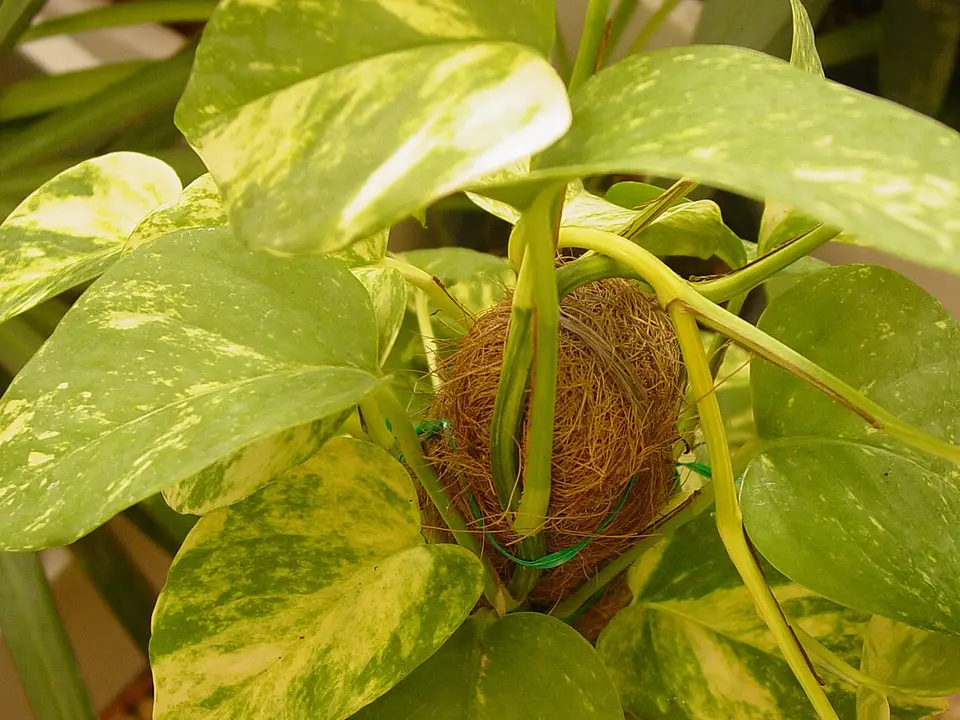
Many pothos are meant to look yellow or pale. Golden pothos has yellow streaks, 'Marble Queen' has white or cream streaks, and 'Neon' is bright lime green all over. If the color is in streaks or covers healthy, firm leaves, and new leaves have it too, that is the plant's normal coloring, not a problem. [1, 2]

Overwatering or underwatering?
Both can cause yellowing and blackened leaf edges, so check the soil and roots, not just the leaves. Soil that stays wet and brown roots point to overwatering; bone-dry soil and limp, drooping vines point to underwatering. [2, 3]
Low light fades color but rarely yellows
In low light pothos keeps growing but loses its variegation and brightness. That is fading, not yellowing; move it to brighter, indirect light. [2, 3]
How to prevent it
- Water only when the soil has dried, then water thoroughly and let it drain.
- Use an airy, well-draining potting mix in a pot with drainage holes.
- Give bright, indirect light; avoid direct sun on the leaves.
- Keep the plant between about 60 °F and 85 °F, away from vents and cold windows.
- Feed lightly in spring and summer, and repot every year or two.
- Check new plants for pests and keep them apart from your other plants for about six weeks.
Questions people ask
Should I cut off yellow pothos leaves?
Yes. Removing yellow leaves keeps the plant tidy, and selectively pruning long vines encourages new growth. Fix the underlying cause first, or new leaves will yellow too. [3, 2]
How often should I water a pothos?
There is no fixed schedule. Water when the soil has dried, then water thoroughly so it reaches all of the roots. How often that is depends on light, temperature and pot size. [1, 2]
Is it normal for pothos to lose its lower leaves?
Yes. Older leaves yellow and drop naturally over time, so long vines often end up with leaves mostly at the ends. It's only a concern if many leaves yellow at once or new leaves are affected. [3]
Sources
Facts on this page were checked against these sources on November 6, 2026. The wording and illustrations are our own.
- How to Grow Pothos Indoors (Epipremnum spp.): Care, Cultivars, and Common Problems (HGIC 1568). Clemson Cooperative Extension, Home & Garden Information Center. Published Jan 30, 2026.
- Pothos as a Houseplant. Penn State Extension. Updated Sep 29, 2025.
- Pothos, Epipremnum aureum. University of Wisconsin–Madison Division of Extension, Wisconsin Horticulture.
- Common Houseplant Insects & Related Pests (HGIC 2252). Clemson Cooperative Extension, Home & Garden Information Center. Updated Sep 10, 2021.
Spotted a mistake? Report an error and we'll check it against the sources and update the page.