Why are my monstera leaves turning yellow?
Short answer
The most common cause is overwatering: the mix stays wet, the roots start to rot and the lower leaves yellow. A telltale sign on monstera is leaves that “sweat” droplets. Other causes are soil drying out for too long, too little light, too little fertilizer for a fast grower in a crowded pot, and cold or drafts.
Quick check: what do you see?
Start with the row that matches your plant best, then jump to that cause for how to confirm it and fix it.
| What you see | Most likely cause |
|---|---|
| Lower or inner leaves yellowing, mix still wet, droplets on the leaves | Overwatering and root rot Most common |
| Lower leaves yellowing and dying, leaves curling, mix bone dry | Soil drying out for too long |
| Pale or yellow leaves, leggy stems, new leaves without holes or splits | Too little light |
| Older leaves yellowing and browning; roots crowding the pot, not fed for months | Too little fertilizer, or a crowded pot |
| Leaves yellowing, drooping and dropping after a cold spell or near a cold window | Cold, drafts and poor light |
Compare the symptoms
Illustrations, not photos: drawn to show the typical pattern of each cause. Free to reuse.
- Overwatering and root rot
- Soil drying out for too long
- Too little light
- Too little fertilizer, or a crowded pot
- Cold, drafts and poor light
The 5 causes, and how to fix each
1. Overwatering and root rot
Most commonSigns
- The lower and inner leaves yellow or wilt first.
- Water droplets form on the leaves (“sweating”) because the mix is too moist.
- As roots rot, leaves and stems wilt even though the mix is wet.
How to confirm
- Push a finger or a wooden dowel into the mix: moist soil sticks to the dowel or darkens it.
- Slide the plant out of its pot. Healthy roots are white; dark brown to black, possibly soft roots mean overwatering and root rot.
How to fix it
- Stop watering until the mix is quite dry, then water thoroughly and let it dry slightly before the next watering.
- Water less in winter, and pour off any water left in the saucer.
- If just a few roots are rotten, cut them out and repot in fresh, sterile potting mix.
- If most roots are dark, soft and dead, it’s better to replace the plant.
Based on: University of Wisconsin–Madison Division of Extension [1], University of Maryland Extension [2], University of Illinois Extension [5], Clemson Cooperative Extension [4]
2. Soil drying out for too long
CommonSigns
- Lower leaves yellow and die off after long dry spells.
- Leaves wilt and curl.
How to confirm
- The mix is dry and the pot feels light when you lift it.
- Roots that are rusty orange to light brown point to underwatering.
How to fix it
- Water thoroughly, until water runs out of the bottom of the pot.
- If the mix has shrunk away from the sides of the pot, water several times so it soaks back in.
- From then on water thoroughly and let the mix dry only slightly between waterings.
Based on: Clemson Cooperative Extension [4], University of Maryland Extension [2], University of Illinois Extension [5], University of Wisconsin–Madison Division of Extension [1]
3. Too little light
CommonSigns
- Leaves turn pale or yellow.
- New leaves come out without their holes and splits.
- Stems stretch and growth gets leggy.
How to confirm
- New leaves lack holes and splits: monstera only develops them in good light.
How to fix it
- Move it to bright light; in winter it can take direct sun.
- Turn the plant now and then so it grows evenly.
- If you move it outdoors for summer, do it gradually, or the leaves will sunburn.
Based on: University of Wisconsin–Madison Division of Extension [1], Clemson Cooperative Extension [4], University of Illinois Extension [5]
4. Too little fertilizer, or a crowded pot
Less commonSigns
- Older, lower leaves yellow, brown and die.
- Yellowing may start at the leaf edges or spread out from the veins.
- Plants that have filled their pots with roots are especially prone.
How to confirm
- It hasn’t been fed since spring, or roots are crowding the pot: monstera needs frequent repotting.
How to fix it
- Feed regularly from spring until fall.
- Repot into a larger pot of fertile, soilless mix with plenty of root room.
Based on: Clemson Cooperative Extension [4], University of Illinois Extension [5], University of Wisconsin–Madison Division of Extension [1]
5. Cold, drafts and poor light
Less commonSigns
- In cool rooms with poor light, leaves can yellow, droop and fall (a disorder called oedema).
- Brown leaf edges can appear after exposure to cold drafts.
How to confirm
- The plant is near a cold window or door, or the room drops toward 50 °F, below which monstera stops growing.
How to fix it
- Move it somewhere warm, away from cold windows, doors and drafts.
- Improve the light and water less often; damaged leaves won’t recover, but this halts the decline.
Based on: Clemson Cooperative Extension [4], University of Illinois Extension [5], University of Wisconsin–Madison Division of Extension [1]
Look-alikes: what it might not be
Brown edges from dry air
Leaf edges that turn brown, rather than the whole leaf yellowing, are often a sign the humidity is too low. Monstera prefers medium to high humidity. [1]
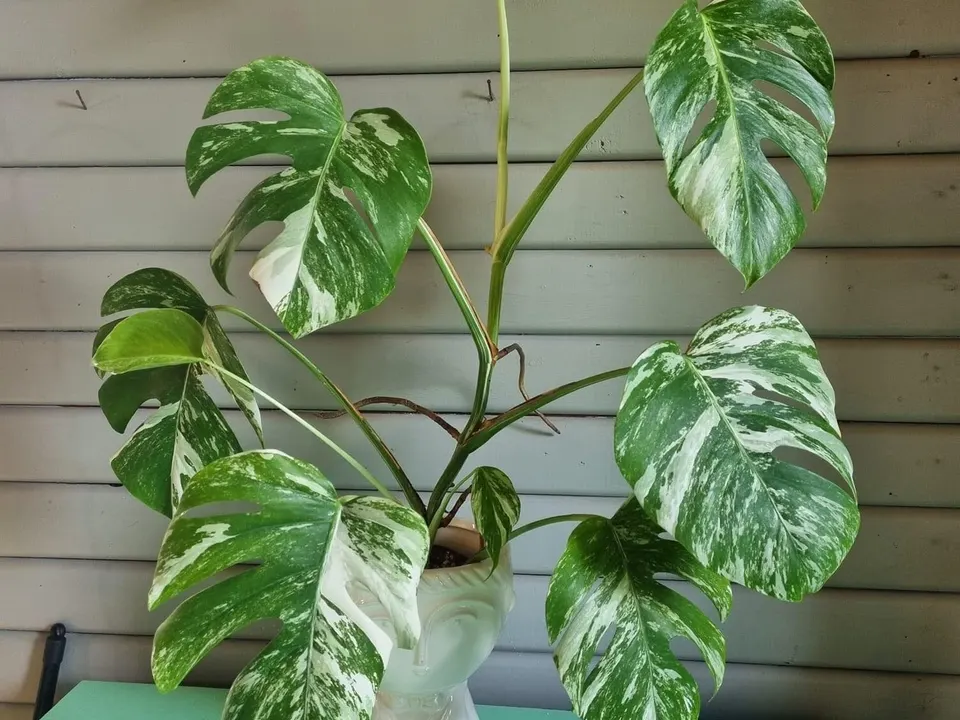
Variegated monsteras are meant to have pale patches
‘Variegata’ and ‘Albovariegata’ have white or cream patches and somewhat smaller leaves. Firm leaves with clear-cut pale sections are normal coloring, not yellowing. [1]

How to prevent it
- Water thoroughly, then let the mix dry slightly; water less in winter.
- Give it bright light so new leaves develop their holes and splits.
- Keep it warm with medium to high humidity, away from cold drafts.
- Feed regularly from spring to fall, and repot as roots fill the pot.
Questions people ask
Why are my monstera’s lower leaves turning yellow?
Most often overwatering: yellowing of the lower and inner leaves is a primary sign of soil that stays too wet. Long dry spells and a shortage of nutrients can also yellow the oldest leaves. [2, 4]
Is my monstera overwatered or underwatered?
Look at the roots. Healthy roots are white; dark brown to black roots mean overwatering; rusty orange to light brown roots mean underwatering. [5]
Why is my monstera dripping water from its leaves?
Leaves “sweat” droplets when the mix is too moist. Water less to prevent root rot. [1]
Will yellow monstera leaves turn green again?
Don’t count on it. If the cause isn’t fixed, yellow leaves go on to turn brown, so focus on fixing the cause so new leaves stay healthy. [3]
Sources
Facts on this page were checked against these sources on November 6, 2026. The wording and illustrations are our own.
- Swiss-Cheese Plant, Monstera deliciosa. University of Wisconsin–Madison Division of Extension, Wisconsin Horticulture. Revised Oct 2026.
- Overwatered Indoor Plants. University of Maryland Extension. Updated Mar 13, 2023.
- Yellowing Leaves on Indoor Plants. University of Maryland Extension. Updated Mar 13, 2023.
- Houseplant Diseases & Disorders (HGIC 2251). Clemson Cooperative Extension, Home & Garden Information Center. Updated Feb 28, 2025.
- Keep houseplants happy with simple solutions. University of Illinois Extension. Feb 22, 2021.
Spotted a mistake? Report an error and we'll check it against the sources and update the page.