Why are my peace lily leaves turning yellow?
Short answer
The most common cause is overwatering: soggy soil rots the roots, and the lower leaves yellow and wilt. Too little water does it too: if the soil dries out too much, the plant wilts and the leaf edges turn yellow. Other causes are too little fertilizer, too little light and the stress of a recent move.
Quick check: what do you see?
Start with the row that matches your plant best, then jump to that cause for how to confirm it and fix it.
| What you see | Most likely cause |
|---|---|
| Lower or inner leaves yellowing, soil still wet, plant wilting anyway | Overwatering and root rot Most common |
| Whole plant drooping, soil dry, leaf edges turning yellow | Soil drying out too much |
| Older, lower leaves yellowing and browning; not fed or repotted in a long time | Too little fertilizer, or pot-bound |
| Pale or yellowish leaves, leggy growth, few or no flowers, in a dim spot | Too little light |
| Some yellowing or dropped leaves in the weeks after a move | Stress after a move |
Compare the symptoms
Illustrations, not photos: drawn to show the typical pattern of each cause. Free to reuse.
- Overwatering and root rot
- Soil drying out too much
- Too little fertilizer, or pot-bound
- Too little light
- Stress after a move
The 5 causes, and how to fix each
1. Overwatering and root rot
Most commonSigns
- The lower and inner leaves yellow or wilt first.
- The plant wilts even though the soil is wet, because rotting roots can’t take up water.
How to confirm
- Push a finger or a wooden dowel into the mix: moist soil sticks to the dowel or darkens it.
- Slide the plant out of its pot. Healthy roots are white; roots that are dark brown to black, and may be soft, mean overwatering and root rot.
How to fix it
- Stop watering until the soil is quite dry, then start a new, less frequent schedule.
- Pour off any water left in the saucer, and make sure the pot drains.
- If just a few roots are rotten, cut them out and repot in fresh, sterile potting mix.
- If most roots are dark, soft and dead, it’s better to replace the plant.
- After about two weeks, feed with a houseplant fertilizer. If there’s no improvement two weeks later, repot in fresh soil.
Based on: University of Maryland Extension [2], University of Illinois Extension [5], Clemson Cooperative Extension [4], Clemson Cooperative Extension [1]
2. Soil drying out too much
CommonSigns
- The whole plant wilts and droops.
- Leaves and their edges turn yellow.
- After long dry spells, lower leaves yellow and die off.
How to confirm
- The mix is dry to the touch and the pot feels light when you lift it.
- Roots that are rusty orange to light brown point to underwatering.
How to fix it
- Water thoroughly, until water runs out of the bottom of the pot.
- If the mix has shrunk away from the sides of the pot, water several times so it soaks back in.
- From then on keep the soil moist but not soggy, letting it dry only slightly between waterings.
Based on: Clemson Cooperative Extension [1], Clemson Cooperative Extension [4], University of Maryland Extension [2], University of Illinois Extension [5]
3. Too little fertilizer, or pot-bound
CommonSigns
- Older, lower leaves yellow, brown and die.
- Yellowing may start at the leaf edges or spread out from the veins.
- Plants that have filled their pots with roots are especially prone.
How to confirm
- It hasn’t been fed in spring or summer, or repotted for years.
- Roots grow out of the drainage holes or circle on top of the soil: it’s pot-bound.
How to fix it
- Feed with a balanced liquid houseplant fertilizer (such as 20-20-20) at a quarter of the label strength, every six to eight weeks in spring and summer.
- If it’s pot-bound, repot into a pot just 1–2 inches wider, with fresh potting mix.
- Don’t overdo it: too much fertilizer burns the leaf tips and roots brown.
Based on: Clemson Cooperative Extension [4], University of Illinois Extension [5], Clemson Cooperative Extension [1]
4. Too little light
Less commonSigns
- Leaves turn pale or yellow.
- Stems stretch toward the light and growth gets leggy.
- Few or no flowers, even on a plant more than a year old.
How to confirm
- A plant over a year old that won’t flower is usually short of light.
How to fix it
- Move it to bright, indirect light.
- Keep it out of direct sun, which scorches the leaves.
- Turn the pot now and then so it grows evenly.
Based on: Clemson Cooperative Extension [4], University of Illinois Extension [5], Clemson Cooperative Extension [1]
5. Stress after a move
Less commonSigns
- Some yellowing or leaf drop in the weeks after the plant is moved or brought home.
How to confirm
- It started soon after a move, and the soil, roots and light all check out.
How to fix it
- Give it time: leaf drop after a big change usually lasts only about three weeks.
- If the yellowing goes on longer than a few weeks, try another spot and adjust watering slightly.
Based on: University of Illinois Extension [5], Clemson Cooperative Extension [4]
Look-alikes: what it might not be
Yellow between green veins
If the tissue between the veins turns yellow while the veins stay green, and the plant is stunted, Clemson Extension points to magnesium deficiency rather than watering. Your local extension office can help you confirm and correct it. [1]
Brown tips aren’t the same problem
Leaf tips and edges that turn brown, rather than yellow, usually come from too much fertilizer or from the soil drying out too much. [1]
Green-tinged flowers are normal
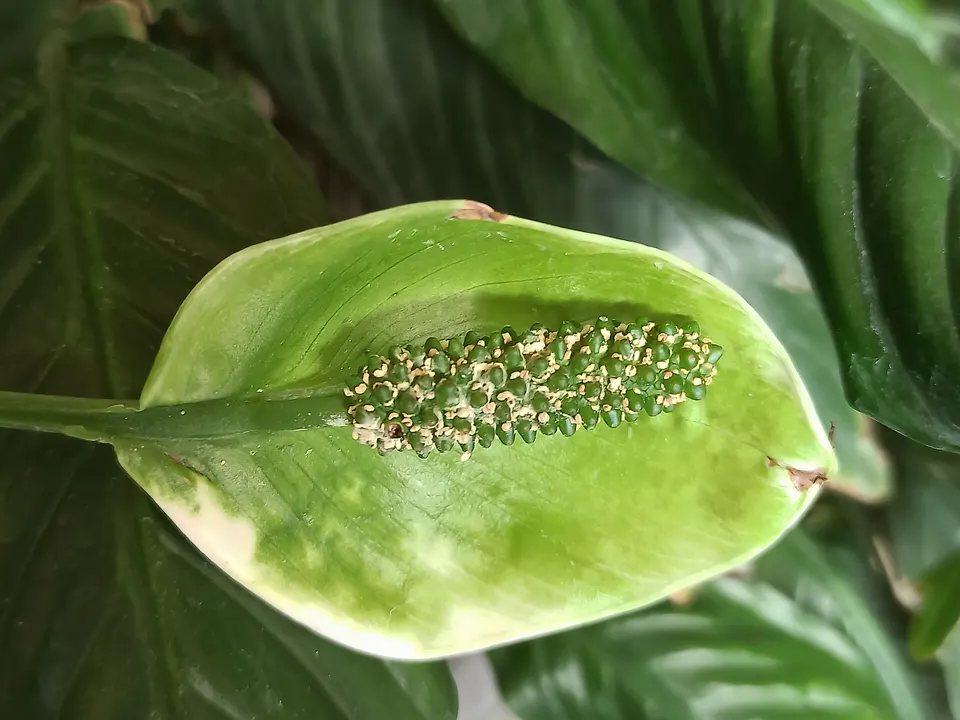
The long-lasting white flowers naturally turn pale green as they age. That’s not yellowing or disease. [1]

How to prevent it
- Keep the soil moist but not soggy, and never leave the pot sitting in water.
- Give it bright, indirect light, out of direct sun.
- Feed lightly, every six to eight weeks in spring and summer, at a quarter strength.
- Repot into a pot 1–2 inches wider when roots circle the surface or poke out of the drainage holes.
- Keep it at about 68–85 °F by day, away from heating and air-conditioning vents and below-60 °F spots.
Questions people ask
Is my peace lily overwatered or underwatered?
Check the soil and roots. Wet soil and dark brown to black roots mean overwatering; dry soil, a light pot and rusty orange to light brown roots mean underwatering. Healthy roots are white. [5, 2]
Why is my peace lily drooping with yellow leaves?
Both extremes cause it: soil that dries out too much makes the plant wilt and the leaf edges yellow, while soggy soil rots the roots so the plant wilts even though it’s wet. Feel the soil before you water. [1, 2, 4]
Will yellow peace lily leaves turn green again?
Don’t count on it. If the cause isn’t fixed, yellow leaves go on to turn brown, so focus on fixing the cause so the new leaves stay green. [3]
How often should I water a peace lily?
Whenever the soil has dried out slightly. Keep it moist but not soggy, use room-temperature water, and never let it stand in a saucer of water. [1]
Sources
Facts on this page were checked against these sources on November 6, 2026. The wording and illustrations are our own.
- Peace Lily (HGIC 1512). Clemson Cooperative Extension, Home & Garden Information Center. Revised Feb 15, 2022.
- Overwatered Indoor Plants. University of Maryland Extension. Updated Mar 13, 2023.
- Yellowing Leaves on Indoor Plants. University of Maryland Extension. Updated Mar 13, 2023.
- Houseplant Diseases & Disorders (HGIC 2251). Clemson Cooperative Extension, Home & Garden Information Center. Updated Feb 28, 2025.
- Keep houseplants happy with simple solutions. University of Illinois Extension. Feb 22, 2021.
Spotted a mistake? Report an error and we'll check it against the sources and update the page.